Main Content
Introduction to Labor Relations Process


Are Unions Valuable?
There are several suggestions that are often made today as to why unions are no longer valuable in the United States. Critics of unions often suggest that unionized workers have a negative impact on the macroeconomy (i.e., lower profits and GDP, and higher unemployment). Others suggest that unions are no longer necessary because we have strong employment laws that protect workers. Finally, others suggest that enlightened companies and HR departments have made unions unnecessary. Consider the following in each of these areas.
Some Impacts of Changing Union Density on the Macroeconomy and Workers’ Wages and Benefits
It is hard to ignore the correlation between wage levels and union density in the United States. Consider the fact that, as of 2003, according to William Quigley, 1 in 4 U.S. jobs paid less than a living wage with no benefits. As we can see in Figure 1.4, during the period of steady union density, wages increased as productivity increased; however, as union membership began to decline, wages stagnated while productivity continued to climb.

We also see in Figure 1.5 that as union density has declined, the share of income going to the middle class has declined as well. And corporate profits have increased as a share of GDP (Figure 1.6).
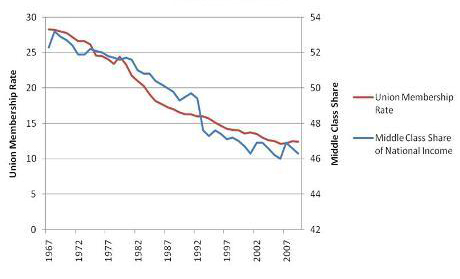
Figure 1.5. As Union Membership Decreases, Middle Class Income Shrinks. From "Declining Union Membership Contributes to Rising Income Inequality, Study Finds," by L. Clawson, 2011, Daily Kos. (https://www.dailykos.com/stories/2011/08/05/1003649/-Declining-union-membership-contributes-to-rising-income-inequality-study-finds)

During the period of sustained union density—depicted in light blue (Figure 1.7), real incomes for families in all socioeconomic quintiles increased, with a slightly larger increase for those in the bottom quintile. As union density decreased, the overall gains did as well (Figure 1.8), but the distribution of those gains showed a dramatic change, with the greatest share of gains going to the top 5% and fewer gains going to each quintile down the socioeconomic ladder.


Some would argue that unions are no longer necessary due to U.S. employment laws that have been passed (often as a result of the labor movement). However, consider some of the following.
Unions have traditionally bargained for items such as leave, pensions, and better pay (the bread-and-butter issues, so to speak). Unions have been extremely successful at making gains in these areas (consider the union wage premium and union threat effect discussed earlier and also discussed in Chapter 2). Figure 1.9 illustrates how the United States has no laws that guarantee any form of paid leave and very limited (in terms of covered employers and employees and the manner and amount of leave) unpaid leave (FMLA). While the United States has laws prohibiting discrimination and harassment on the basis of protected statuses—race, color, national origin, religion, gender, sexual orientation, disability, age status over 40), discrimination and harassment are still rampant in the American workplace—with as many as 80% of women experiencing gender based harassment in the workplace. The legal system does not offer a lot of hope for those targeted for such harassment or discrimination, as fewer than 2% of complaints of harassment or discrimination end in successful litigation for targets (Rights on Trial). The majority of workers in the United States also face status-blind harassment (workplace bullying) with no legal remedies. Concerted activity and collective bargaining agreements present a more promising avenue for targets of such behaviors.

Figure 1.9. Paid Time Off Around the World. From "Overworked in America: 12 Charts That Will Make Your Blood Boil," by D. Gilson, 2011, Mother Jones. (https://www.motherjones.com/politics/2011/05/speedup-americans-working-harder-charts/)
