
HRER504:
Pre-Campus: Getting Started and Introduction to Labor Relations Process

Overview
This lesson will provide the framework for this course and the labor relations process. In this lesson, you will be introduced to the field of employment relations in the United States and define key terms that are common to the field and that will be used throughout the semester. In the first part of this lesson, we will take steps to define employee relations and the employment relationship and how these relate to human resource management. We will discuss why labor relations is important. We will also outline the objectives of the employment relationship for all stakeholders— employers, employees, unions, society, and public policy. This lesson will also present the basic features of the contemporary U.S. labor relations system and describe the current pressures on the U.S. labor relations system. A key takeaway from this first lesson is that labor relations is a process. This process goes through the steps of the strategic/organizing phase, the bargaining phase, and the management of the CBA phase. The process is impacted by environmental factors, such as the sociocultural environment, the economic environment, the legal environment, and labor history.
In the next sections of this lesson, we will explore the labor problem and the three big goals of the labor relations process. We will learn four basic theories about how to best solve the labor relations problem. These are referred to by Budd as the "four schools of thought." Each of these schools of thought is built on assumptions about the roles and behaviors of the stakeholders in the labor relations process (employers, employees, unions, the government, etc.). These assumptions are used to build models of how the labor problem can best be solved.
Looking at the “labor problem” from the perspective of workers, the problem has existed throughout labor history. It entails issues or concerns over unsafe work, long hours, or low wages. Looking at the problem historically, the labor problem at the end of the 19th century and early 20th century included common workweeks of 50–60 hours and even more than 70 hours in some industries. Wage levels were often well below a “living wage.” Workplace safety issues included daily dangerous work, such as the average of one death per day at the Pressed Steel Car Company, outside of Pittsburgh, and larger tragedies such as the Triangle Shirtwaist Fire of 1911, where 146 workers perished. In fact during World War I, more workers died on the job than in the war. The insecurity of work was also part of the labor problem, with workers being fired indiscriminately. This labor problem has a particular toll on workers individually, but also had a negative impact on the macroeconomy.
Today, while many workers are insulated from much of this labor problem, the reality is that the problem persists. In the United States in particular, workers work longer hours than in any other industrialized countries. For many low-wage workers in the United States today, these working hours mean working for multiple employers. The wages of American workers also continue to be part of the labor problem, with median wages (meaning that half of all workers in the U.S. earn below this level) and the minimum wage well below any semblance of living wages. The COVID-19 pandemic of 2020 brought to light concerns about workplace safety in the United States, but these concerns also have been present outside of the pandemic, with the high rates of workplace injuries and injuries and deaths related to workplace injuries in jobs from meatpacking to warehousing to hospitality, and catastrophic events, such as the explosions at the Sago and Upper Big Branch mines, West, Texas, and Deepwater Horizon. Finally, fear of job loss continues to be the largest workplace stressor for U.S. workers, as the United States continues to follow a standard of employment at will (workers can be fired for any reason with or without any notice—unless the reason is specifically prohibited by a law, such as Title VII of the Civil Rights Act).
Using both labor history and current outcomes in the labor relationship, you will begin to test the theories/schools of thought about the labor relations process and will develop your own theories and concepts about how the labor relationship is best managed.
Learning Objectives
After completing this lesson, you should be able to do the following:
- Define the key terms that will be used throughout this course.
- Define employee relations and the employment relationship and how this relates to human resource management.
- Define the objectives of the employment relationship.
- Explain why studying labor relations is important.
- Describe the basic features of the contemporary U.S. labor relations system.
- Describe the current pressures on the U.S. labor relations system.
- Describe how the labor relations process builds on itself and how each step of the process impacts all other steps.
- Describe the four distinct schools of thought or views of labor relations and the employment relationship and the assumptions of each school.
- Test the assumptions of the four schools of thought by applying lessons from labor history and current outcomes in the labor relationship.
- Identify and define what unions do in terms of outcomes for workers, employers and organizations, and society.
- Compare employee representation through labor unions to other methods of workplace governance.
- Describe the origins of the labor movement and why workers have historically attempted to form unions.
- Explain the role of the government in the development of labor history.
- Identify the major events, leaders, and organizations in labor history.
- Identify the accomplishments of employee efforts to organize.
- Explain how labor history impacts the current labor relations process in the United States.
- State the lessons we can take from labor history and apply them to today.
Readings and Activities
Check the Course Schedule for specific details on what to read this week.

Four Schools of Thought
There are four different broad views about how we should engage in the labor relations process. These are referred to as schools of thought. Each school of thought is based on a series of assumptions about the importance of the three goals of the labor relations process, how to achieve those goals, the purpose of work, and the level of and locus of workplace conflict.
The four schools of thought are the following:
- the neoliberal school of thought (also referred to as the mainstream school of economics),
- the human resource management school of thought,
- the industrial relations school of thought, and
- the critical industrial relations school of thought.
The Neoliberal School of Thought
This assumes that the role of work is simply to produce goods and services as efficiently as possible and to create profit and growth. The value of an employee lies in what they can contribute to that process. They assume that all interests in the labor relations process are balanced through a competitive marketplace—in particular the labor market.
The Human Resource Management School of Thought
This school recognizes the value of employees beyond what they contribute to their workplace. This school of thought assumes that there is no real inherent conflict between employees and employers. While this school of thought recognizes that the labor market does create the labor problem, it believes that the source of this problem is bad management. It believes that good management can always resolve these problems but also believes that unions might need to exist to address the bad managers/companies. It recognizes employee voice as being important and believes that this is best accomplished through open-door policies of good management.
The Industrial Relations School of Thought
This school of thought most clearly matches the legal system of labor relations in the United States. Those who follow this school of thought recognize an inherent conflict between workers and management. The view of this conflict is that it is pluralistic, with some shared interests and others that are in conflict. For those who follow this school of thought, they see the primary locus of conflict at the organizational or firm level. They believe that worker voice is important and that collective bargaining is the best means of ensuring such voice and resolving conflicts.
The Critical Industrial Relations School of Thought
The critical industrial relations school of thought is often aligned with socialism or Marxism. Those who follow this school of thought believe that workers have commonly shared interests that are in conflict with the ownership or management class. Those who follow this school of thought believe that the best way to resolve the labor problem is through worker ownership of the means of production.
Test the Assumptions
We can test these assumptions through outcomes.
Are nonunion workers’ problems solved, or does the labor problem persist? Are there still issues around wages, benefits, safe working conditions, hours, job security, and other terms and conditions of employment? Has the marketplace resolved these issues? Does good management or the presence of HRM resolve these issues?
Do labor unions resolve these problems?
Are these problems common among large groups of workers that cross over various employers (i.e., low-wage workers, retail workers, hospitality workers, teachers, etc.), or are the problems/conflict located within specific organizations?
The Field of Employment Relations
Human resources (HR) and employment relations (ET) are distinct subfields, and together they make up HRER.

HR and ER are different and distinct subfields of management. HR can be defined as the set of organizational functions that focus on issues related to personnel management. These include recruitment, hiring, compensation, benefits, performance management, safety, wellness, training and development, and other related functions.
ER, on the other hand, is the set of organizational functions by which an employer or management interacts with a union or an employee association formed as part of a union organizing drive. This interaction usually takes place in the context of the following settings: an organizing drive to convince employees to unionize, the negotiation of a labor contract or agreement through collective bargaining, or the grievance and arbitration process through which the parties try to resolve disputes over contract application or enforcement. Each of these steps will be addressed in much greater detail throughout the course.
As Figure 1.1 suggests, HR exists in all workplaces. That is to say that the HR functions of hiring and recruitment, payroll, benefits administration, training and development, and others must be performed in every workplace, union or nonunion, big or small, factory or office, private sector or public sector, profit or nonprofit. On the other hand, ER happens in unionized workplaces (where employees have at some point chosen to be represented by a union). It also happens, on a much reduced scale, in the small number of nonunion workplaces where a union is seeking to represent the employees during a union organizing drive. ER does not, however, happen in the vast majority of nonunion workplaces where there is no union activity.
Practitioners in the field of employment relations are involved in the management and administration of this relationship. The two main groups of practitioners include individuals who represent employer interests (titles vary but include employment relations managers, labor relations managers, and sometimes, directors of human resources), and those who represent the interests of employees and their unions (local union leaders, union staff representatives, and business agents). Two other groups of practitioners are involved in the employment relations process. They include representatives of government agencies that assist the parties and monitor the laws pertaining to the relationship (the Federal Mediation and Conciliation Service and the National Labor Relations Board) and professional neutrals (usually arbitrators) who help unions and employers resolve disputes that may arise between them.
Labor Relations Process
One of the most important things to keep in mind throughout this course is that labor relations is a process rather than a series of stand-alone events or factors. Each part of this process impacts all other parts. The process is impacted by both internal and external factors and pressures, such as the macroeconomy, sociopolitical environment, legal environment, and history. And likewise, these processes and how unions and employers engage in them have an impact on these external factors. When we think about the labor relations process itself, we can define three major phases: the strategic phase, the bargaining phase, and the day-to-day phase. Let’s look at each phase in more detail.

The Strategic Phase
This phase includes setting broad labor relations strategies and also includes the specific tactics around organizing drives.
In the strategic phase, employers determine their general labor relations strategies, their views towards unionization, and how they will address organizing drives or the potential for organizing drives.
For unions, they establish their goals, the type of union they will be, what workers they will look to represent/organize, how they will relate to other unions, and what tactics they will look to use in organizing drives.
Collective Bargaining Phase
This phase only takes place if a union has organized the workers of an employer/facility. Here, the union, as representative of the employees, will negotiate with management to reach a collective bargaining agreement. This phase is impacted by all other phases, but as just one example, the way that management has decided to handle an organizing drive will impact the tone of collective bargaining. A knock-down, drag-out organizing drive would of course likely lead to a high level of animosity that would, of course, impact the bargaining.
Day-to-Day Management Phase
The final phase occurs after a contract, or collective bargaining agreement (CBA), is reached. We often refer to this as the day-to-day management phase. At this phase, the contract is enforced. There will often be different views of what contract clauses mean. As management operates from day to day, they may of course violate the CBA, or the union or members may believe management has violated the CBA. This will lead to disputes that are resolved through what is known as the grievance process. Again, we can think about how the tone and outcomes of the negotiating phase would impact this phase of the labor relations process.
The Goals and the Stakeholders
The labor relations process affects and is affected by a number of different groups and individuals. All of these are called stakeholders in the process. These include businesses/owners, management teams, workers, unions, society, consumers, and the government. Each of these groups and the individuals within them have various goals and objectives, and they are all important.
Employees
Consider your goals as an employee. What do you want to get out of working? Money, health insurance, a feeling of accomplishment, a sense of self-worth? Organizational behavior studies of workers tell us that employees want all of these and more. How do you want to be treated as an employee? Like a machine or with dignity and respect? Would you like to have input into the nature of your job? (Budd, 2008). We know from workplace studies that dignity, respect, and voice are all important to employees. When we think about the goals and issues of workers, we need to think about the multitude of different employment situations. Often, we find ourselves focused on white collar and/or high-skilled workers, but the majority of American workers fall into other categories: blue collar workers, retail workers, hospitality workers, low-wage workers, and contingent workers, and we need to make sure that we consider the issues of these workers as well.
Management
Think about the goals you have as a manager or might have as a manager. These goals might include meeting your daily objectives, operating efficiently, having consistency from your employees, having employees who show up for work, and having employees who provide organizational citizenship behaviors and discretionary effort.
Owners
Consider the goals you might have as an owner. These might include receiving a return on your investment, making money, or achieving some other mission.
Society
Consider the possible goals of society. These might include the ability to access and purchase needed and/or wanted goods and services, and societal outcomes like inequality, poverty, homelessness, and unemployment.
Government
Consider the goals of the U.S. government. Enumerated goals include establishing a more perfect union, establishing a system of commerce that benefits the country and its citizens, and ensuring life, and liberty, and happiness for all.
Three Goals of the Employment Relationship
All of these goals affect and are affected by the labor relations process and, therefore, there are multiple goals for labor relations. In this course, we specifically focus on three broad goals, which encompass many of these other goals (as well as others).
Budd (2008) states that the three objectives of the employment relationship are efficiency, equity, and voice:
- Efficiency: The productive, profit-maximizing use of labor to promote economic prosperity.
- Equity: Fairness in the distribution of economic rewards, the administration of employment policies, and the provision of employee security.
- Voice: The ability of employees to have meaningful input into workplace decisions.
There is often inherent conflict between these goals, and it falls on the labor relations process to strike a balance between the three. For instance, equitable treatment might reduce flexibility and efficiency. Employee voice might make decision-making more cumbersome and therefore less efficient. Unions centralize power to better achieve equity but often become less responsive to individuals, and sometimes those individuals will lose some voice.
References
Tension Between Employers and Employees
Ultimately, the study of the past is helpful in understanding the present because it reveals certain foundational themes and patterns present over time. In the history of employment relations, one of the basic themes we see is that the interests of employers and employees were often in conflict and that the resultant confrontations were heated and sometimes violent. A brief discussion of the economic system within which employers and employees interacted then, and continue to interact today, will provide some insight into the root of this conflict and into why it continues today in the context of a more structured, more civilized relationship.

Employers Want to "Keep Costs Low"
From its very beginning, the United States has operated under a "capitalist" economic system in which markets determine the price of goods and services. Even in the emerging capitalism of the 1700s and 1800s, the goal of employers was to make as much money as possible or, in terms economists would use, to maximize profits. The general business model for maximizing profits then (and now) was to sell your product for as much as the market would bear, while keeping your costs of production as low as possible. And since labor comprises a significant part of an employer's costs, keeping these costs down was critical to a business's success.
Employees Want "Higher Wages/Salaries"
Employees, however, also operated under the same economic system as employers. When entering the "labor market" to sell their services, their goal was to maximize what they received for their efforts. This was in direct conflict with the goal of employers to keep labor costs as low as possible. Thus, conflict was inevitable as employees tried to push the price of their labor up while employers tried to push down those same costs. The issues around which this inherent conflict centers were so central, so important to the parties involved that disputes over them sometimes escalated into violence.
Core Tension Continues Today
It is important to recognize that there is still inherent conflict between employers and employees over wages and benefits, as well as other terms and conditions of employment that fundamentally shape the nature of the contemporary relationship between labor and management. In 1935, however, a systematic process for channeling and resolving the inevitable conflict between employees and employers was established through a historic piece of legislation called the National Labor Relations Act (NLRA). We will discuss the NLRA in more detail in future lessons. While conflict still exists between the parties, the conflict is now worked out in a different manner, and physical violence no longer plays a role in the process.
Macroeconomic Impact on Labor Relations Boom-Bust Economic Cycle
Another important foundational theme that becomes apparent as we study the evolution of labor–management relations is the effect of the economic context in which that relationship takes place. Market economies tend to operate in cycles. Economic activity (production, employment, profits) increases during boom periods and decreases during downturns or recessions (bust periods). The balance of power in the conflict between employers and employees has been greatly influenced by these cycles.
Bust Periods
During periods of economic downturn or recession, employers have historically gained a significant advantage over employees and the unions they formed. Unemployment has played a big role in this relationship. During recessions, when the unemployment rate has been higher than normal, employers have been able to use the ready pool of excess labor to replace workers who demanded too high a price for their labor or went on strike. This is why employers had an advantage in the relationship.
Boom Periods
In contrast, employees were in a better position to push their wages higher during boom periods. During a boom period, when there was low unemployment and almost everyone had jobs, few workers were available to serve as replacements. Employees were aware of this and could press for pay increases and even go on strike without fearing that they would be replaced by workers willing to work for less. This gave them an advantage over employers.
Boom–Bust Historical Examples
During the 19th century, these cycles occurred in roughly 20-year intervals. If we plot the major confrontations between unions and employers on the timeline in Figure 1.2, we see that during upturns in the economy, employees and unions often went on the offensive and tried to negotiate better wages and working conditions; during downturns, employers tended to go on the offensive and successfully confronted labor.

Boom: 1857–1867
As Figure 1.2 indicates, the first national unions in this country were formed in the 1860s when the economy was booming. The first national labor union in the United States was, unimaginatively, called the National Labor Union.
Bust: 1867–1877
When the economy declined between 1867 and 1877, employers went on the offensive against these new unions. The destruction of the coal miners' union in northeastern Pennsylvania (which culminated in the hanging of the "Molly Maguires") and the defeat of the early railroad unions during the Rail Strike of 1877 during this period are two examples of employers taking advantage of favorable economic conditions to take on unions.
Boom: 1877–1887
From roughly 1877 to 1887, the economy grew strong and unions regrouped. It was during this period that many modern unions were founded. The American Federation of Labor (AFL) was formed, and the Knights of Labor's membership grew to over 700,000.
Bust: 1887–1897
However, when the economy, again, fell into decline between 1887 and 1897, employers regained the upper hand and became much more aggressive in fighting unions. The defeat of the steelworkers in Homestead, Pennsylvania, at the hands of Andrew Carnegie and Henry Clay Frick in 1892 (the Homestead Lockout) and of the workers who manufactured Pullman cars in 1894 (the Pullman Strike) was the result.
Boom–Bust Cycles Today
The U.S. economy continued to experience booms and busts throughout the 1900s, as it does right through the present. However, after the downturn of the 1890s, these cycles ceased to occur in the regular 20-year patterns. Over the last hundred years, they have been much harder to predict. Still, when they occur they continue to influence labor–management relations, much as they have throughout the last 200 years.
Labor relations is important in both unionized and nonunion environments. All managers should understand labor relations and how this process impacts all working environments. Managers need to be aware that U.S. labor laws apply to both workplaces where unions currently exist (organized) and nonunion workplaces (unorganized). The study of labor relations also helps to reveal the consequences of poorly managed workforces and helps to explain historical, social, and political influences on business. Many of the tactics and practices within labor relations also apply in all working environments, including methods and tactics for resolving conflicts, understanding the goals of workers, and understanding how to negotiate agreements and resolve disputes as well as how to adopt and define organizational policies and practices.
The Union Threat Effect
Again, we return to the question of why labor–management relations is worth studying if only 12.1% of the U.S. workforce belongs to unions and engages in collective bargaining. One reason, as suggested by the above discussion, is that union density is significantly higher than this percentage in some geographic locations (the Northeast, Midwest, and far West) and in some industries (government, utilities, transportation, and telecommunications). In those communities and in those industries, unions play a very important role.
There is, however, a second reason why the subject of labor–management relations is worth studying. This reason is that the influence of unions reaches well beyond their membership and the unionized workplaces in which they work. This phenomenon is called the union threat effect.
The union threat effect occurs when, in order to remain competitive in a local labor market and to keep their employees from forming a union, nonunion employers raise their wages and benefits to levels approaching—or even matching—those of a direct competitor who is organized.
One way to illustrate this is to look at two employers engaged in a similar business in the same town.
Union Threat Effect Example

- As shown in Figure 1.3, unionized Company A pays better and has better benefits than nonunionized Company B.
Company B's employees will undoubtedly learn what Company A's employees are making. And they may come to the conclusion that if they had a union they might also receive the same wages and benefits that Company A provides its employees. Under these circumstances, it would not take long for Company B's employees to initiate a union organizing drive, a drive that could result in the unionization of Company B.
- Company B's management wants to avoid company unionization.
The management of Company B wants to avoid this at almost any cost, so they will often, reluctantly, raise the pay and benefits of their employees. Even though it may end up offering compensation similar to the unionized employees at Company A, Company B probably will still feel it is better off because it will not have to deal with a union. One of the main reasons employers make every effort to keep their employees from organizing is that unions force employers to share (through bargaining) some of the decision-making over the day-to-day operations of the workplace. By providing wages and benefits similar to their unionized competitors, nonunion employers avoid losing further control and flexibility over their workforce.
- The union threat effect takes place.
Clearly, if there were not a union present in Company B's geographic area, there would be no reason for the employer to raise its wages and benefits. This is why the threat of unionization has a much greater impact than the union-density figures suggest. Walters and Mishel (2003) further studied this union threat or spillover effect in How Unions Help All Workers, published by the Economic Policy Institute. In this study, Walters and Mishel conclude that unionization has an upward effect on the wages of all workers, improves benefits for all workers, decreases inequality, and leads to safer workplaces.
Labor Relations and Labor Unions
To better analyze the U.S. system of labor relations, we also need to consider what it is that labor unions do. How do unions address issues of hours of work, wages, workplace safety, and job security? Do unions do more than the current U.S. labor laws in each of these areas, or have the laws made unions largely irrelevant? Has HR addressed these issues adequately, or do we see that in the absence of unions the labor problems persist? The articles you have been assigned to read in this lesson help us to gain an understanding of what unions do.
What Do U.S. Unions Do?
As we read through the information in the Budd text and the articles for this lesson, we see that unions and union density have a clear effect on workers’ wages, safety, terms and conditions of work, organizations, and the economy. We also know that unions have had an impact on history and the passage of employment laws.
The Union Wage Premium
Unionized workers enjoy a number of premiums in their terms of employment over similarly situated nonunion counterparts. Union workers are more likely to have expanded health care benefits, retirement plans, paid time off, just cause rights, and seniority rights in their workplace. Union workers also enjoy a direct wage premium of about 15% over their nonunion counterparts.
Are Unions Valuable?
There are several suggestions that are often made today as to why unions are no longer valuable in the United States. Critics of unions often suggest that unionized workers have a negative impact on the macroeconomy (i.e., lower profits and GDP, and higher unemployment). Others suggest that unions are no longer necessary because we have strong employment laws that protect workers. Finally, others suggest that enlightened companies and HR departments have made unions unnecessary. Consider the following in each of these areas.
Some Impacts of Changing Union Density on the Macroeconomy and Workers’ Wages and Benefits
It is hard to ignore the correlation between wage levels and union density in the United States. Consider the fact that, as of 2003, according to William Quigley, 1 in 4 U.S. jobs paid less than a living wage with no benefits. As we can see in Figure 1.4, during the period of steady union density, wages increased as productivity increased; however, as union membership began to decline, wages stagnated while productivity continued to climb.

We also see in Figure 1.5 that as union density has declined, the share of income going to the middle class has declined as well. And corporate profits have increased as a share of GDP (Figure 1.6).
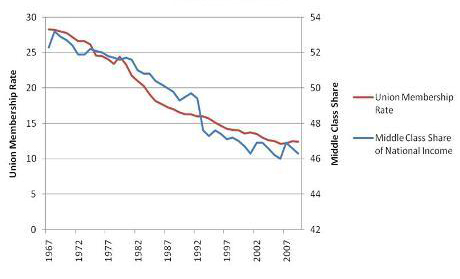
Figure 1.5. As Union Membership Decreases, Middle Class Income Shrinks. From "Declining Union Membership Contributes to Rising Income Inequality, Study Finds," by L. Clawson, 2011, Daily Kos. (https://www.dailykos.com/stories/2011/08/05/1003649/-Declining-union-membership-contributes-to-rising-income-inequality-study-finds)

During the period of sustained union density—depicted in light blue (Figure 1.7), real incomes for families in all socioeconomic quintiles increased, with a slightly larger increase for those in the bottom quintile. As union density decreased, the overall gains did as well (Figure 1.8), but the distribution of those gains showed a dramatic change, with the greatest share of gains going to the top 5% and fewer gains going to each quintile down the socioeconomic ladder.


Some would argue that unions are no longer necessary due to U.S. employment laws that have been passed (often as a result of the labor movement). However, consider some of the following.
Unions have traditionally bargained for items such as leave, pensions, and better pay (the bread-and-butter issues, so to speak). Unions have been extremely successful at making gains in these areas (consider the union wage premium and union threat effect discussed earlier and also discussed in Chapter 2). Figure 1.9 illustrates how the United States has no laws that guarantee any form of paid leave and very limited (in terms of covered employers and employees and the manner and amount of leave) unpaid leave (FMLA). While the United States has laws prohibiting discrimination and harassment on the basis of protected statuses—race, color, national origin, religion, gender, sexual orientation, disability, age status over 40), discrimination and harassment are still rampant in the American workplace—with as many as 80% of women experiencing gender based harassment in the workplace. The legal system does not offer a lot of hope for those targeted for such harassment or discrimination, as fewer than 2% of complaints of harassment or discrimination end in successful litigation for targets (Rights on Trial). The majority of workers in the United States also face status-blind harassment (workplace bullying) with no legal remedies. Concerted activity and collective bargaining agreements present a more promising avenue for targets of such behaviors.

Figure 1.9. Paid Time Off Around the World. From "Overworked in America: 12 Charts That Will Make Your Blood Boil," by D. Gilson, 2011, Mother Jones. (https://www.motherjones.com/politics/2011/05/speedup-americans-working-harder-charts/)
There Is Power in a Union, What Unions No Longer Do
There is little disputing the power of the labor movement throughout much of the 20th century. Unions and the movement as a whole were able to secure incredible victories for workers—from safe work, to the 8-hour workday, to the passage of the National Labor Relations Act, to a guaranteed minimum wage and overall improved conditions of work. However, by the end of the 20th century, much of this power had waned. Union density had experienced a dramatic decline since its height in the middle of the century, and concessionary bargaining had become the norm. Labor researchers began exploring the reasons for this declining power and effects of such decreased power among unions. Books such as the seminal work from Mike Parker and Martha Gruelle (Labor Notes, 1999) Democracy Is Power argued for the need for democracy in unions to restore power. In a similar vein, Julius Getman (Restoring the Power of Unions: It Takes a Movement, 2000) argued that unions could indeed still be powerful, but they needed to be both democratic and willing to take strong, concerted actions, using Unite Here as a model. Rosenfeld, in What Unions No Longer Do, presents evidence that the waning power of unions has led to an increase in socioeconomic and racial inequality and sees restoration of a powerful labor movement, “the most prominent and effective voice for economic justice in the United States,” as the only path to address these issues of inequality.
Unions and Inequality
According to a book from Joseph Stiglitz (The Price of Inequality), the United States is paying a high cost as a country for the record levels of inequality in terms of wages, income, and wealth that currently exist in the United States. Wilkinson and Pickett (The Spirit Level) link these rising levels of inequality to numerous social problems, such as poverty, homelessness, incarceration rates, crime rates, and distrust.
Unions and Mobility
Freeman, Han, Madland, and Duke (2015) found that unions have a significant impact on intergenerational upward socioeconomic mobility. Some of their findings include the following:
- A 10-percentage-point increase in a geographic area’s union membership is associated with low-income children ranking 1.3 percentile points higher in the national income distribution.
- A 10-percentage-point increase in union density is associated with a 4.5% increase in the income of an area’s children.
- Children of non-college-educated fathers earn 28% more if their father was in a labor union.
To explore this further, this study is included in the optional reading for this lesson.
Unions and Safety
There are numerous studies that look at the relationship of unions to workplace safety. Generally, these studies show that unionized workplaces tend to be safer but may have more reports of safety violations due to the stronger voice of union workers. One of these studies by Morantz specifically looks at the mining industry. Morantz found that unionization is associated with a 14%–32% drop in traumatic injuries and a 29%–83% drop in fatalities.
This study is available in the library resources.
History of Labor Relations
One way to view the history of labor relations in the United States is as a series of actions, responses, and counterresponses by workers/unions, management/owners, and the government.

Most workers today are employees selling their labor for a wage or a salary. Only 10% of U.S. workers are self-employed, and half of employees in the United States today work for large organizations with 500 or more employees. However, that has not always been the case. At the end of the 1700s, the majority of free Americans were self-employed (farmers, shopkeepers, blacksmiths, shoemakers). Businesses were small and local, and the “large” businesses that did exist were largely in the iron industry and employed around 25 employees on average.
By the end of the 1800s, the picture of employment in the United States had changed dramatically. U.S. Steel employed 170,000 employees. Ford’s Highland Park factory outside Detroit had 15,000 employees. For all purposes, the era of self-employment in the United States was over. Working for a paycheck became widespread, and workers now had fixed working hours, and punctuality and constant work effort replaced autonomous work habits. Business became big business, characterized by hierarchical, centralized control, and concentrated wealth and power.
With this shift from entrepreneur to employee, workers lost control of the means, methods, timing, and other terms and conditions of their work. In order to maintain some level of control, employees began to band together to protect their crafts. This led to the earliest unions representing craftspeople (craft unionism), with a focus on the methods of production (job control unionism).
In 1866, the National Labor Union (NLU) was formed. This “union” more closely resembled a federation of smaller unions, much like today’s AFL-CIO. The NLU emphasized political activity to bring reform and campaigned for an 8-hour workday.
In reaction to this burgeoning labor movement, employers turned to the courts for assistance. While President Lincoln supported workers’ right to organize and kept the federal government out of labor disputes, courts were not always as friendly to workers. Business owners reached out to courts to help them to prevent workers from organizing. Employers argued that unions of workers were criminal conspiracies or unlawful trusts, and many courts agreed. Workers were often jailed, and injunctions were also issued against organizing efforts. In 1806, the Philadelphia Cordwainers (shoemakers) were convicted of criminal conspiracy. Juries often consisted entirely of landowners, as to be eligible for jury duty, one had to own property at that time in U.S. history.
The macroeconomy also played a role in the development of the labor movement in the United States. During a depression in the 1870s, employers demanded steep wage cuts, while dividends and executive salaries remained unchanged. Employers in the railroad industry implemented 10% cuts across the board, and this led to a series of strikes across the country and across other industries. This strike wave became known as the Great Uprising of 1877. In response, employers hired Pinkertons and called on national guards and the militia to prevent the stoppage of trains and to help quell the uprising.
Around the same time, work continued to shift from regional employers to large national employers, and the labor movement shifted with it. Labor unions also became national, first with the National Labor Union and later with the Knights of Labor (KoL). By the 1880s, the Knights of Labor was the most influential organization in the labor movement. It had 700,000 members, included a broad working class in its membership, and unlike other unions welcomed women into its ranks, with over 50,000 female members. The KoL adopted the concept of uplift unionism, with the goal of elevating the moral, intellectual, and social lives of all workers, including managers. They opposed militant actions, including strikes, and instead believed that education of those opposed to the labor movement was the best path to solving labor problems. The KoL primarily focused on the 8-hour day and decent pay.
The Haymarket Tragedy of 1886 led to the demise of the KoL. Two years earlier, the KoL had marked May 1, 1886, as the deadline for the implementation of an 8-hour day. Numerous strikes occurred in 1886 to support this deadline for the 8-hour day. The KoL encouraged members to write letters rather than strike. The strikes were largely repressed by police, and in Chicago’s Haymarket Square a rally was held to protest the police repression. During the rally, a bomb was thrown into the police, and the police fired on the protestors. Eight anarchists were found guilty of killing police officers in what could only be defined as a kangaroo court. Four of the convicted were hanged. The public backlash against the KoL led to its demise as the lead organization of the labor movement, even though it had no involvement in the protests or tragedy.
As the KoL lost influence and power, the American Federation of Labor (AFL) emerged. Twenty-five national unions came together in response to what was seen as the failures of the KoL and formed the AFL. Samuel Gompers, a leader within Cigar Makers Union, became the first president of the AFL. The AFL developed the concept of pure-and-simple unionism, or what is referred to as business unionism. This form of unionism is still a primary form—if not the primary form—of unionism in the U.S. labor movement today.
Under the AFL, the struggle between employers, like Carnegie Steel and Standard Oil, and employees continued. Strikes, such as the Homestead Strike of 1892 and the Pullman Strike of 1894, often led to violent confrontations between workers and company-hired guards and militia. One battle between Pinkerton guards and striking workers at Homestead led to seven strikers and three Pinkertons being killed. Clashes during the Pullman Strike led to 13 deaths.
At the turn of the 20th century, another labor union emerged—the International Workers of the World (IWW), or the Wobblies. The IWW, then as now, followed many of the concepts of the critical industrial relations school of thought. Unlike the AFL, they believed that unskilled workers needed to be included in the unions of the time. They believe in solidarity among all workers and the need to engage in concerted and militant actions to make gains for workers. At the time of the emergence of the IWW, the United States was seeing record levels of inequality as wages stagnated and the corporate profits of companies like Carnegie Steel and Rockefeller’s Standard Oil exploded. Taylorism, or scientific management, emerged, and rather than making work easier, it was used to make workers expendable. The IWW led one of the most successful strikes up to that time, the Textile Strike of 1912. However, as the U.S. entered World War I, the IWW was accused of being un-American and sympathizing with communists during the Red Scare. Hundreds of Wobblies, including Big Bill Haywood, were found guilty of opposing the war. Twelve hundred IWW union members were rounded up at one point and left for dead in the New Mexico desert.
In the early 1900s, U.S. employers continued to push for the open-shop movement. Unions were depicted as violating individual freedoms, and employers fought against having to recognize or negotiate with any unions. This employer push again led to violent clashes, perhaps the worst of which ended in what is known as the Ludlow Massacre. In 1913, when workers at a Rockefeller gold mine in Colorado attempted to organize, they were forced out of their company-owned homes. The Ludlow workers set up a tent city outside of the company town. In April of 1914, the Colorado militia opened fire on the tent city, killing 10 workers. After the gun battle, the militia burned the tent city. Wives and children of the striking miners were hiding under the tents, and two women and 11 children were burned to death. In 1921, another battle over the open shop occurred at Blair Mountain, West Virginia. The battle between striking miners and deputies funded by the mine owners lasted for a week, and the workers were forced to give up as federal troops moved in to protect the mines.
In the 1920s, perhaps in response to the publicity of the Ludlow Massacre, employers turned to a new method of avoiding unions. They created the personnel function and adopted what is known as welfare capitalism. This concept was marked by the concept of the company doing for workers what a union would charge them to do. Many of the employment practices mirror today’s HRM practices. Tactics also included the creation of company-run or -owned unions. Of course, as quickly as gains were given to employees under this concept, they could also be and often were taken away.
The mid-1920s to mid-1930s were marked by two big events in the labor movement: the first national legislation directly addressing unionization and the right to concerted activity, and the emergence of industrial unions and the Congress of Industrial Unions (CIO). In 1926, Congress passed the Railway Labor Act (RLA). Given the importance of the railway industry to the U.S. economy, and understanding the impact of strikes on the industry, the primary purpose the RLA was to avoid strikes. However, the RLA was also the first law protecting employee rights to engage in concerted activity and collective bargaining. The RLA provides mediation services and establishes boards to resolve grievances and disputes between employers and workers in the transportation industry.
In 1935, Congress passed the Wagner Act, guaranteeing the right to form unions, engage in concerted activity, and collectively bargain for a wide swath of American workers in the private sector. Within 6 years, union membership had tripled to 8.4 million workers—a union density of 23%. As work continued to shift to being centered around an employer, with skilled and unskilled workers working for the same employers, with the same working conditions and the same workplace issues, industrial unionism emerged as an alternative to craft unionism. Under John Lewis’ leadership, seven unions formed a new Committee of Industrial Organization (CIO). The CIO unions were eventually kicked out of the AFL, and after helping to lead a successful sit-down strike at GM, the committee became its own union federation—the Congress of Industrial Organizations, formed in 1938.
The new rights under the RLA and Wagner Act (NLRA) led to the growth of labor union density and union power as the United States moved into World War II. However, due to concerns about the ability of the United States to produce the needed materials to engage in the war, the Roosevelt administration formed the National War Labor Board (NWLB) to prevent labor disputes. The NWLB led to increased job security for workers and the establishment of fringe benefits as part of total compensation packages. However, the NWLB also required a freeze on wages and prohibited negotiations over wages. This freeze on wages, while corporate profits surged, played a role in the strike wave of 1945–46 that followed the end of the war.
After the war, the labor movement saw a number of positive moves for workers—the joining of the labor movement with the civil rights movement and the first public sector unions and public sector labor rights—as well as some steps back—the passage of Taft-Hartley and the PATCO strike. However, from the passage of Taft-Hartley in 1947 to today, union density has declined, and at times the decline has been dramatic. In response to this union density decline, labor unions and federations have made a series of attempts to reverse the decline.
In the early 2000s, the AFL-CIO put greater emphasis on organizing. Despite this, a new labor federation—the Change to Win Federation—emerged with a promise of a greater emphasis on organizing and growing the labor movement. Amendments to the NLRA have also been consistently proposed under Democratic administrations, including the Carter, Clinton, and Obama administrations. Republican administrations at the state and federal levels have continued to push for expansion of the number of right-to-work states and the limitation of public sector bargaining rights. In 2018, the Supreme Court ruled that all public sector workers have the right to opt out of paying all union dues, making all public sector workers right-to-work employees. Despite these setbacks, the labor movement saw successes in the 2018–19 teacher strike wave, the successes of the Fight for $15, and the movement of workers in the fast-food and other service industries. New proposed amendments to the NLRA, known as the PRO Act, are active in both houses of Congress. A review of labor history might help U.S. to predict how and where the labor movement will go from here.
Learning from History
Learning about labor history can teach us a lot about our current labor relations environment. Our labor history has shaped our labor law, our labor practices, and even the tone of the employment relationship. Santayana suggests that we study history to learn from the past—not only to avoid repeating the mistakes of the past but also perhaps to learn and attempt to emulate the successes of the past.
As we look at labor relations history in relation to today, we can see that there are often more similarities than we might initially believe. During the industrialization period that led to the growth of the labor movement, we saw that there was a great deal of consolidation, monopoly, and monopsony power. Corporate giants like Standard Oil and Carnegie Steel dominated their consumer and labor markets. While antitrust laws passed early in the 20th century were meant to address and break up these monopolies, by many measures we see just as much of not more monopoly/oligopoly and monopsony/oligopsony power. Nobel-winning economist Joseph Stiglitz points to this power as leading to the ability of rent seeking as well as domination and exploitation of workers.
We hear in the documentary The Inheritance that a mantra existed during this industrialization period: “Why hire a man for a dollar, when you can hire a child for a dime?” Child labor was a norm in industries in the United States. Today, we also see millions of adult Americans out of work and seeking work, while American children (high schoolers) work on a regular basis. We also see some of the worst forms of child labor in the United States, especially in farming. We also see these worst forms of child labor throughout U.S.-company supply chains, from the minerals of the Congo mined by children as young as 4, to the fast-fashion industry exploitation of child labor in Bangladesh, and in nearly every industry in between, child labor continues to be an industrial norm.
In the years covered in The Inheritance, we see immigrant labor being exploited and often used against domestic laborers. The lesson vignette about the Pressed Steel Car Company shows us how immigrant labor was used as a weapon against workers and also shows some of the drastic exploitation that occurred. Today in the U.S., we see this pattern continue. From the U.S. Supreme Court ruling in Hoffman Plastic Compounds, which allowed employers to avoid back pay to undocumented workers who were fired in violation of the NLRA, to the exposés of immigrant workers being exploited in the meatpacking industry (e.g., Blood, Sweat, and Fear by Lance Compa) that read so much like the Sinclair’s The Jungle, to the JI Pickle Case that exposed a pattern of brutal exploitation of immigrant laborers in the United States.
At the same time that we see the exploitation of immigrants both yesterday and today, we see similarities in the praise of wealth. Today, we praise titans of industry, like Bill Gates, Jack Welch, and Jeff Bezos, in the same way that Frick, Carnegie, Gould, Rockefeller, and Mellon were praised in the time of the robber barons.
We also see an overlap in the outcomes of yesterday and today, with 1 in 4 wage earners in the United States earning below a living wage, even before the recessions of 2000, 2008, and 2020. Today in the United States, 75% of wage earners live paycheck to paycheck, despite returning to the incredible amount of working hours we saw before the battle for the 8-hour workday was won. Disasters like the Triangle Shirtwaist fire of 1911 seem to be mirrored by the disasters at the Upper Big Branch mine; the Sago Mine; West, Texas, fertilizer plant; and the Deepwater Horizon oil rig.
In terms of business practices, it is hard to miss the overlap between yesterday’s welfare capitalism and today’s human resource management or to overlook the similarities between the company unions and self-managed work teams and other company-organized work teams.
The deeper we dig into this comparison of yesterday and today, the more we have to ask ourselves if we are heeding the advice of Santayana. Are we learning from our history or are we repeating the mistakes of the past?
References
Santayana, G. (1905). Reason in common sense. Charles Scribner's Sons.
Historical Timeline
The Impact of the Economy and Government Today
The state of the economy and the role that the government chooses to play in labor–management relations still influence the balance of power between the parties. Although the boom-and-bust cycle does not operate in predictable 20-year cycles anymore, unions still have greater bargaining power when the economy is growing and unemployment is low. And employers still have the upper hand in the relationship when the economy is in decline and unemployment is higher than normal.
Similarly, if the executive and legislative branches of government at the national level are more sympathetic to the interests of either employers or unions, they can use their influence with government agencies, the courts, and the legislative process to advantage one side or the other. The advantage either side has when these two factors benefit labor or management simultaneously (as they did in the 1980s) is even more significant.
As you think about the evolution of labor–management relations from the 1800s through the present, keep in mind the role the economy and the government played, and continue to play, in helping to determine which party would have the greater bargaining power at any given time.

Pressed Steel Car and the McKees Rocks Strike of 1909
The following italicized print is taken from The Point of Pittsburgh, Charlie McCollister (pp. 181–186)
The Pressed Steel Car Company was situated in the Schoenville Section of McKees Rocks …. The population of McKees Rocks was divided into three parts. The old settlers, mainly Scots, English, and German, owned much of the business and real estate, and many lived on the higher ground above the industrial and commercial “Bottoms”; the next, second and third generation workers, mainly Irish and German, performed most of the skilled craft and maintenance work in the factory ….The Slavs, referred to as “Hunkies” … were regarded with contempt by the corporation and by many native born workers as “the least intelligent, the least independent … the most content to be driven like slaves.”
The company purposely split the workforce into nationality and language groups in order to communicate with them, but also to keep the groups divided. The plant had the reputation of being a “slaughterhouse” with serious accidents as an almost daily occurrence. Lurid accounts in the press call the plant “the last chance”: “When some poor Hunky … is maimed and mangled in his work, some forman or other petty “boss” pushes the bleeding body aside with his foot to make room for another living man, that no time is lost in the turning out of pressed steel car. The new man often works for some minutes of the dead boy until a labor gang takes it away. A former county coroner, Joseph G. Armstrong, testified about the appalling death toll. It seemed to me that the deaths average about one a day …. Investigation made it look to me as though a lot of young fellows who were operating the cranes did not care much whether or not a “hunky” laborer was hit every now and then.
On Saturday, July 10, 1909, the men were paid, and many were shorter in their pay than usual. A demand was raised to know the pay rate. Upon management’s refusal to talk, shop after shop walked out until virtually the entire plant was struck. The company immediately contacted Pearl Berghoff, “king of the strikebreakers”… Berghoff received five dollars a day for each body delivered to the plant. He quickly mobilized some 500 strikebreakers, who began arriving on the morning of July 14. Most entered the plant by rail, but deputies initially escorted contingents on foot to the plant gate.
When they reached the gate they were greeted by a storm of bricks, stones and clubs …. Terrified, the strike-breakers broke ranks and ran for their lives, leaving the policemen to look out for themselves. The latter drew their revolvers and this act seemed to further enrage the already maddened crowd. With the men shouting oaths and the hundreds of women in the crowd screaming with rage, the strikers closed in and began hand-to-hand battle. A policeman fired into the crowd, his shot striking a man in the stomach, inflicting a wound that will probably be fatal … (from a newspaper account at the time).
The McKees Rocks strike continued throughout the summer, with violence erupting several times, and the company continued to bring in strikebreakers. At one point, 300 strikebreakers were shipped in via a riverboat that was turned away at the dock by striking workers. Despite that, by August of 1909, over 1,000 strikebreakers were working at Pressed Steel Car Company, under even more deplorable conditions than prior to the strike.
Violence escalated in August as matters came to a head. On August, 11 a Croation striker trying to prevent the entry of strikebreakers, was killed by a deputy …. In August 15, a second gun battle prevented another steamer from landing replacement workers. On the 17th, 8,000 strikers and their supporters rallied at Indian Mound. The IWW took public control of the strike … tension continued to build until August, 22, which became known as “Bloody Sunday.” Strikers boarding a trolley searching for scabs were confronted by an armed deputy who opened fire. In the ensuring fight, the deputy, Harry Exler was killed. A company of state troopers was called in to restore order; and in the bloody confrontations that followed, ten more men including eight strikers were killed. The next day, the troopers stormed through “Hunkeyville” attacking men and women indiscriminately…
On August 25, ignoring threats on his life, the Socialist leader and oft-times candidate for President, Eugene V. Debs, then at the height of his powers and popularity, addressed a crowd of 10,000 from the Indian Mound. He called the strike the “greatest labor fight in all my history in the labor movement”; one that signaled a “new spirit among the unorganized, foreign-born workers in the mass production industries.”
On September 8, a settlement offer was made that ignored many of the workers' issues, but the workers' families were “hungry,” and so they proclaimed victory and “marched back into the plant.”
Once there, however, the company began to backtrack from the agreement. This triggered a walkout by 4,000, primarily immigrant worker, on September 15. The following day, 2,000, mostly native born workers marched behind a huge American flag toward the immigrant worker picket line. The immigrant workers opened their ranks and allowed the marchers to enter the gate unscathed, and most of the immigrants followed the Americans insider shortly after. The skilled men exercised their shared management control by slowly squeezing out the IWW supporters and other resisters. From a claimed membership of 6,000 inside and outside the plant in the immediate aftermath of the strike, by 1912 the IWW chapter had dwindled to 20 members.
Think About It
How does the McKees Rocks strike align to the other occurrences you have read about in the material on labor history? How did the employers react to the demands of workers? Should the employer have been required to negotiate or at least listen to the workers’ demands? Were the workers unreasonable in their demands or tactics? Were there any victories for labor in the strike? Did the strike itself prove the potential for labor solidarity between immigrant and native workers? Did the strike mark a change in the actions/willingness to engage by immigrant workers?