P ADM 506: Management Information Systems for Public and Health Administration (3)
Course Description
P ADM 506 is one of the core courses for the MPA degree. It involves the purpose, design, and implementation of management information systems (MIS). These systems and related technologies form the foundation of the majority of organizations in the public, nonprofit, and private sectors.
Most employees use computers and networks in the workplace for applications such as word processing, e-mail, preparing reports, and completing transactions based on the use of databases and spreadsheets. A range of information and communication technologies (ICTs) support these computers and systems. These technologies help to provide access to data and information, as well as to communicate organizational information to others, both within and between organizations.
The course is designed for managers or other professionals who need to develop the knowledge and skills in order to be able to effectively plan, design, manage, and use information systems resources to support the information needs of an organization. Managers and professionals in all organizations need to have a basic understanding of the roles and nature of information technologies (ITs) which are fundamental to the efficient functioning of organizations. Managers and professionals should also have a basic knowledge and appreciation of computer applications that are critical to proper organizational functioning, including spreadsheets, databases, and web applications.
Access to data, as well as the ability to organize, process, and manipulate it, helps to create the types of information that are vital to the completion of productive work. Organizations need information to support their operations, management, and staff. Supervisors and employees rely heavily on information to perform their work and to conduct the monitoring and planning of organizational tasks and services for which they are responsible. The information often needs to be transmitted to others within an organization, as well as to clients, to other organizations, and to the public.
Organizational success often depends on clients and customers receiving timely and accurate information. Within the government, health care, nonprofit, and other sectors, the complex relations among units, levels, and departments, makes information storage, retrieval, and transmission critical factors in achieving desired productivity. Thus, information can be considered to be a valuable organizational resource. Managing this resource is a critical managerial function. Planning, designing, and supporting the systems needed to deliver information in a timely manner to organizational stakeholders are also critical managerial functions.
PREREQUISITES: None.
CLASS FORMAT: The class topics will be explored through online lectures, skill building assignments, exercises based on the text and online content, and a combination of team and individual assignments.
Course Objectives
This course is designed to develop students’ knowledge and skills concerning the applied management of information technology, including
- the role of information technology in organizations, their environments, and their management;
- current technologies involved in the management of information resources;
- the information needs of customers, clients and other stakeholders (e-government, e-business, etc.);
- issues involved in developing IT applications to support organizational and managerial needs;
- emerging managerial and public policy issues related to information technologies; and
- a range of relevant software applications, including Excel, Access, and web editing.
Required Textbook
The following material is required and may be purchased from MBS Direct:
- Laudon & Laudon, Essentials of Management Information Systems, 9th Edition, Prentice Hall, 2011 (ISBN-10: 0136110991; ISBN-13: 9780136110996).
- Friedrichsen, Microsoft Access 2010, Illustrated Series, Brief, Thomson/Cengage, 2010 (ISBN-10: 0538748273; ISBN-13: 9780538748278).
For pricing and ordering information, please see the Barnes & Noble College website.
Materials will be available at Barnes & Noble College approximately three weeks before the course begins. It is very important that you purchase the correct materials. If your course requires one or more textbooks, you must have exactly the correct text required (edition and year).
Many of the University Libraries resources can be utilized from a distance. Through the Libraries website, you can
- access magazine, journal, and newspaper articles online using library databases;
- borrow materials and have them delivered to your doorstep—or even your desktop;
- get research help via email, chat, or phone using the Ask a Librarian service; and
- much more.
You can view the Online Students' Library Guide for more information.
You must have an active Penn State Access Account to take full advantage of the Libraries' resources and services. Once you have a Penn State account, you will automatically be registered with the library within 24–48 hours. If you would like to determine whether your registration has been completed, visit the Libraries home page and select My Account.
Technical Requirements
For this course we recommend the minimum World Campus technical requirements listed below:
| Operating System | Windows Vista, Windows 7, Windows 8*; Mac OS X 10.5 or higher *Windows 8 support excludes the tablet only RT version |
|---|---|
| Processor | 2 GHz or higher |
| Memory | 1 GB of RAM |
| Hard Drive Space | 20 GB free disk space |
| Browser | We recommend the latest ANGEL-supported version of Firefox or
Internet Explorer. To determine if your browser fits this criterion,
and for advice on downloading a supported version,
please refer to the following ITS knowledge base article: Supported Browsers and Recommended Computers.
Note: Cookies, Java, and JavaScript must be enabled. Pop-up blockers should be configured to permit new windows from Penn State websites. Due to nonstandard handling of CSS, JavaScript and caching, older versions of Internet Explorer (such as IE 6 or earlier) do not work with our courses. |
| Plug-ins | Adobe Reader [Download from Adobe]
Flash Player (v7.0 or later) [Download from Adobe] |
| Additional Software | Microsoft Office (2007 or later) |
| Internet Connection | Broadband (cable or DSL) connection required |
| Printer | Access to graphics-capable printer |
| DVD-ROM | Required |
| Sound Card, Microphone, and Speakers | Required |
| Monitor | Capable of at least 1024 x 768 resolution |
If you need technical assistance at any point during the course, please contact the Service Desk.
For registration, advising, disability services, help with materials, exams, general problem solving, visit World Campus Student Services!
Grades
The following grade distribution will be used in this class:
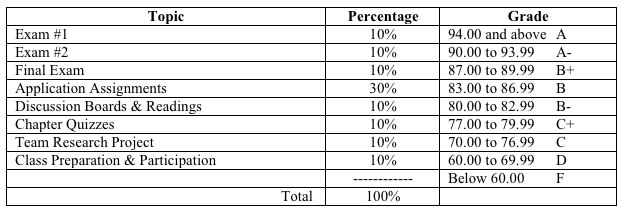
The Instructor reserves the right to revise this distribution.
Note: All application and project work must be completed and submitted before a course grade is assigned. Grading will take into consideration participation and will be adjusted to include both team and individual contributions. Assignment grades may be adjusted up or down based on individual contributions, teamwork, and peer evaluations.
Please refer to the University Registrar's information about University grading policies.
If, for reasons beyond the student's control, a student is prevented from completing a course within the prescribed time, the grade in that course may be deferred with the concurrence of the instructor. The symbol DF appears on the student's transcript until the course has been completed. Non-emergency permission for filing a deferred grade must be requested by the student before the beginning of the final examination period. In an emergency situation, an instructor can approve a deferred grade after the final exam period has started. Under emergency conditions during which the instructor is unavailable, authorization is required from one of the following: the dean of the college in which the candidate is enrolled; the executive director of the Division of Undergraduate Studies if the student is enrolled in that division or is a provisional student; or the campus chancellor of the student's associated Penn State campus.
For additional information please refer to the Deferring a Grade page.
Note: If you are planning to graduate this semester, please communicate your intent to graduate to your instructor. This will alert your instructor to the need to submit your final grade in time to meet the published graduation deadlines. For more information about graduation policies and deadlines, please refer to Graduation at the Chaiken Center for Student Success.
Team Assignments and Grading
Workgroups and teams have become critical structures within organizations. Students will be placed on teams during the semester for the purpose of completing various assignments. These assignments are meant to develop skills in applying topics to real world problems and situations, as well as to enhance the material covered in the course. Students will be required to evaluate themselves and fellow team members on team assignments. Both peer and instructor evaluations will be used to assess team assignment grades.
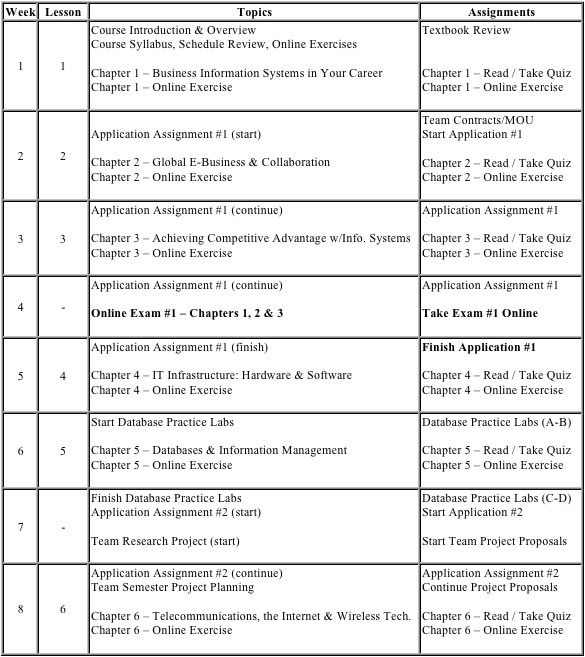
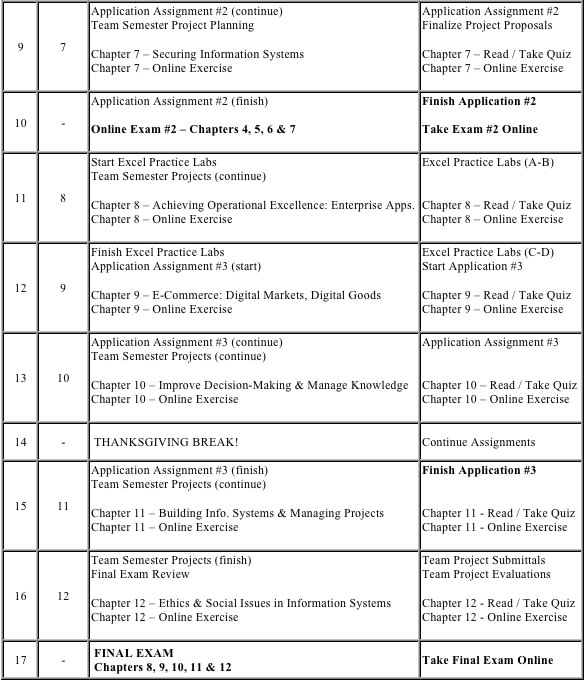
Course Schedule, Topics, and Assignments:
- Course begins: Monday, August 22, 2011
- Course ends: Friday, December 9, 2011
- Course length: 16 weeks
The schedule below outlines the activities and topics to be covered in this course, along with the associated time frames and assignments. To stay on track, you should plan to print the schedule and follow it closely. The topics and learning activities scheduled for each of the 12 lessons in the course are listed in the Course Schedule. Each lesson covers one week. As you study each week's lesson, please focus on the specific list of learning activities for that lesson. Note that assignments are due based on the Eastern Time Zone (ET). This ensures that all students have the same deadlines, regardless of where they live.
Formal instruction will end on the last day of class. Provided that you have an active Penn State Access Account user ID and password, you will continue to be able to access the course materials for one year, starting from the end date of the academic semester in which the course was offered (with the exception of library reserves and other external resources that may have a shorter archival period). After one year, you might be able to access the course based on the policies of the program or department offering the course material, up to a maximum of three years from the end date of the academic semester in which the course was offered. For more information, please review the University Course Archival Policy.
Course Requirements
- Active participation in the course is expected. This includes contributing to message boards regularly and communicating with team members in a timely manner.
- All work is expected to be neat, complete, and professional.
- Submitted reports should be typed, double-spaced with 1" margins, and clearly labeled. Your individual or team name, course number, and date should be on each submitted assignment.
- Your work should be properly referenced and adhere to standards of both academic integrity and proper form. Please use APA style for references (http://www.apastyle.org/index.aspx).
- Electronic submittals are to be posted within the ANGEL course environment.
- Teams will be formed by the instructor. Each team will develop and sign a student contract identifying expectations and consequences if individuals fail to meet the expectations. On team assignments, individual contributions will be evaluated by both the instructor and peers. If a team has problems, please bring it to the instructor’s attention so that a solution can be recommended.
- All work is to be completed and turned in by the stated deadline. Assignments turned in late will receive a deduction in points, unless prior approval is obtained for a deadline extension.
- All application and project work must be completed and submitted before a course grade is assigned.
Academic Integrity
According to Penn State policy G-9: Academic Integrity (for undergraduate students in undergraduate courses) and policy GCAC-805 Academic Integrity (for graduate students and undergraduate students in graduate courses), an academic integrity violation is “an intentional, unintentional, or attempted violation of course or assessment policies to gain an academic advantage or to advantage or disadvantage another student academically.” Unless your instructor tells you otherwise, you must complete all course work entirely on your own, using only sources that have been permitted by your instructor, and you may not assist other students with papers, quizzes, exams, or other assessments. If your instructor allows you to use ideas, images, or word phrases created by another person (e.g., from Course Hero or Chegg) or by generative technology, such as ChatGPT, you must identify their source. You may not submit false or fabricated information, use the same academic work for credit in multiple courses, or share instructional content. Students with questions about academic integrity should ask their instructor before submitting work.
Students facing allegations of academic misconduct may not drop/withdraw from the affected course unless they are cleared of wrongdoing (see G-9: Academic Integrity or GCAC-805 Academic Integrity as appropriate). Attempted drops will be prevented or reversed, and students will be expected to complete course work and meet course deadlines. Students who are found responsible for academic integrity violations face academic outcomes, which can be severe, and put themselves at jeopardy for other outcomes which may include ineligibility for Dean’s List, pass/fail elections, and grade forgiveness. Students may also face consequences from their home/major program and/or The Schreyer Honors College.
How Academic Integrity Violations Are Handled
World Campus students are expected to act with civility and personal
integrity; respect other students' dignity, rights, and property; and help
create and maintain an environment in which all can succeed through the
fruits of their own efforts. An environment of academic integrity is
requisite to respect for oneself and others, as well as a civil community.
In cases where academic integrity is questioned, procedures allow a student to accept or contest/appeal the allegation. If a student chooses to contest/appeal the allegation, the case will then be managed by the respective school, college or campus Academic Integrity Committee. Review procedures may vary by college, campus, or school, but all follow the aforementioned policies.
All academic integrity violations are referred to the Office of Student Accountability and Conflict Response, which may assign an educational intervention and/or apply a Formal Warning, Conduct Probation, Suspension, or Expulsion.
Information about Penn State's academic integrity policy is included in the information that students receive upon enrolling in a course. To obtain that information in advance of enrolling in a course, please contact us by going to the Contacts & Help page.
University Policies
Penn State welcomes students with disabilities into the University’s educational programs. Every Penn State campus has an office for students with disabilities, including World Campus. The Disabilities and Accommodations section of the Chaiken Center for Student Success website provides World Campus students with information regarding how to request accommodations, documentation guidelines and eligibility, and appeals and complaints. For additional information, please visit the University's Student Disability Resources website.
In order to receive consideration for reasonable accommodations, you must contact the appropriate disability services office at the campus where you are officially enrolled, participate in an intake interview, and provide documentation. If the documentation supports your request for reasonable accommodations, your campus's disability services office will provide you with an accommodation letter. Please share this letter with your instructors and discuss the accommodations with them as early in your courses as possible. You must follow this process for every semester that you request accommodations.
Students with disabilities participating in internship, practicum, student teaching, or other experiential learning opportunities as part of their degree requirements may also be eligible for reasonable accommodations to ensure equal access and opportunity. These accommodations are determined through an interactive process involving the student, their University supervisor, and the site supervisor. Student Disability Resources can assist students with identifying potential barriers, facilitating accommodation requests, and coordinating with University supervisors to promote inclusive learning experiences.
For information about additional policies regarding Penn State Access Accounts; credit by examination; course tuition, fees, and refund schedules; and drops and withdrawals, please see the World Campus Student Center website.
In order to protect your privacy, course access is limited to those individuals who have direct responsibility for the quality of your educational experience. In addition to the instructor, a teaching assistant or college administrator may be provided access in order to ensure optimal faculty availability and access. World Campus technical staff may also be given access in order to resolve technical support issues.
- Students are responsible for online course content, taking notes, obtaining other materials provided by the instructor, taking tests (if applicable), and completing assignments as scheduled by the instructor. As a general rule, students should plan on logging into the course at least three times per week and spending at least three hours per course credit per week on the course, e.g., if the course is three credits, the student should plan on spending at least 9-12 hours per week on the course, just as they would in a residence course.
- Students are responsible for keeping track of changes in the course syllabus made by the instructor throughout the semester.
- Students are responsible for monitoring their grades.
-
Students must contact their instructor (and teammates when working on any collaborative learning assignments) as soon as possible if they anticipate missing long periods of online time due to events such as chronic illnesses, death in the family, business travel, or other appropriate events. The instructor will determine the minimal log on time and participation required in order to meet course responsibilities. In the event of other unforeseen conflicts, the instructor and student will arrive at a solution together.
- Instructors may require students to provide documentation with the class absence form or other written notification for events such as illness, family emergency, or a business-sanctioned activity.
- Conflicts with dates on which examinations or assignments are scheduled must be discussed with the instructor or TA prior to the date of the examination or assignment.
- Students are responsible for following appropriate netiquette (network etiquette) when communicating with their instructor and classmates. For reference, see the Academic Success Kit.
- Behaviors that disrupt other students’ learning are not acceptable and will be addressed by the instructor.
-
For severe and chronic problems with student disruptive behavior, the following will be applied for resolution:
- Senate Committee on Student Life policy on managing classroom disruptions: Office of Student Accountability and Conflict Response.
- Penn State Values.
Disclaimer: Please note that the specifics of this Course Syllabus are subject to change, and you will be responsible for abiding by any such changes. Your instructor will notify you of any changes.
Copyright © 2011 The Pennsylvania State University