Main Content
Lesson 1: Overview of Autism Spectrum Disorders

Learning Challenges Associated With ASD
Generalization and Maintenance
Some individuals with ASD may experience challenges with learning and skill acquisition that require a different type of instruction and/or instructional support. Some individuals require explicit, systematic instruction, while other individuals require accommodations (supports to help acquire skills), modifications (changing the content to make it easier to learn), or chunking the material (breaking it down into smaller components). One of the main goals of instruction for individuals with ASD is generalization, or the transfer of skills from one setting or environment to another, and with different individuals. When designing instruction, you want to make sure that the skills you teach will be transferred or generalized to other environments and with other people. For example, you might hear teachers say, “You know, he'll only sit in his seat with me” or “He will only respond appropriately with me.” You might think that this is a sign of success, but it isreally not. You want the student to be able to engage in the activity, communication, or behavior with you, with his or her family members, and with another member of their community. If you are supporting a student with skills for telling time, you'll want them to be able to tell time on different clocks/watches/devices. You'll also want them to tell time at home, at school, and in the community. Remember, the ultimate goal of instruction is making sure the students can carry and apply their newly acquired knowledge and skills everywhere they go.
Additionally, once a child learns a skill, it is important for them to maintain that skill over time (maintenance). Someindividuals with ASD may experience challenges in maintaining previously acquired skills, so the ability to perform a particular skill over time cannot be assumed. Individuals with ASD may benefit from some strategies, such as explicit training or visual supports for generalization and maintenance to occur.
Challenges Associated With Core Areas for ASD Support
"Who do you think made the first stone spears? The Asperger guy."
Executive Functioning
Executive functioning is the ability to organize and plan using working memory, inhibiting and controlling impulses, time-management priorities, and new strategies based on what happens in the current situation or what has happened in the past. When you experience challenges in executive functioning can affect your ability to know that you'll have to put your math supplies in your backpack before you go to class, where you'll need them. You might also forget the steps of a sequence ("I’m supposed to do four steps in this task, but I can’t remember past Step 2"). This can be very difficult for students with ASD, making it hard for them to complete tasks that require sequential steps.
Stimulus Overselectivity
Students with ASD may display stimulus overselectivity, wherein they focus on a small detail and may be unable to see the bigger picture. You may also hear this described as "tunnel vision." Because the person is focusing on one small aspect, he or she is unable to pay attention to other parts of an object or other things taking place in the environment. For example, when looking at a car, a child with ASD would not focus on the car as a whole—including the color, shape, and individual parts—but, rather, would overselect, focusing only on the wheels.
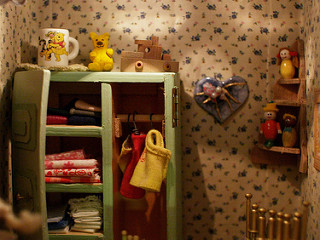
Let’s look at another example. Look at the picture below and ask yourself, “What’s the picture about?” Then check the answer to see if you’re correct.
Answer
A child’s closet.
Now think about how someone with ASD who displays stimulus overselectivity would answer the question. What might they say this picture is about?
Answer
A teddy bear or, perhaps, a heart.
Tunnel Vision as a Strength
It should be noted that this can also be a strength among people with ASD. The author of this webpage, Eva Silvertant, talks about a 2013 study by Robertson and colleagues, which found that people with ASD had greater visual attention than their counterparts in the study without ASD. The webpage author also recalls their personal experience and enhanced attention to detail, where she says, “I think it’s this tunnel vision and focus on details that, metaphorically speaking, made me draw the trees rather than the forest.”
Hyper/Hyposensitivity
Individuals with ASD may often appear to sense the world in different ways than others. They may misinterpret everyday sensory information, such as touch, sound, and movement. For example, some individuals with ASD may find certain sounds or colors disturbing, while other individuals may not even hear the sound or notice the color at all. Both of these examples can create learning challenges for individuals with ASD in the area of attention. Two common terms you may hear are hypersensitive and hyposensitive.
Individuals who are hypersensitive (oversensitive) receive too much information from their senses, so their brains become overloaded. This means they may see, hear, feel, smell, or taste things in a more frequent or extreme manner when compared to other people without hypersensitivity. Some individuals with ASD have intense sensitivity to sound and may find certain sounds painful. Sometimes individuals will cover their ears or wear noise-cancelling headphones to help them tolerate noises.
Individuals who are hyposensitive (undersensitive) may receive too little information, so their brain may have difficulty making sense of what little information there is. This means they may see, hear, feel, smell, or taste the world in a more subdued way when compared to other people without hyposensitivity. For example, an individual with ASD’s sense of touch may be lower than normal, and he/she won’t be able to feel light touches or even pain and temperature extremes.
Here is an interesting video designed to illustrate how hypersensitivity might feel to someone with ASD as they go about their day. Please have a look at this video, “Make it Stop.”