
The Child Savers
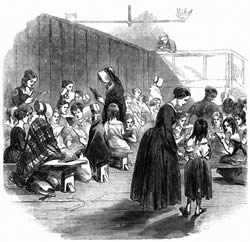 According to Platt, women played a major role in this child-saving movement. Middle- and upper-class women began to agitate for methods through which the children of immigrants, the majority of those children found in the new urban underclass, could be brought under the guidance of more appropriate caretakers. The industrial revolution had elevated a new middle class which joined the ranks of the upper class when it came to ideas about child rearing practices, how one should keep the home, etc. Most households in these middle and upper economic strata were able to hire and maintain domestic help. Having some assistance in running their own households, women became interested in more and more social causes, volunteer work, and political issues of the time.
As was seen in Lesson 1, rapid industrialization and immigration produced disorganized communities centered at the hub of work in urban areas. The reformers, or child savers, viewed the children of this new working class as troublesome and capable of wreaking havoc on the “American” way of life. Indeed, this new class of people, growing almost exponentially in numbers, was viewed by the middle and upper classes as capable of catapulting society downward into chaos and depravity. Women, then, took it upon themselves to step in, with the authority of the state behind them, to get control over these wayward youth; the intention of which was to save the children from poor parenting and living conditions that would soon push them into a life of crime.
Thus, Platt and others have suggested that the child savers were not exclusively concerned about what was best for the children of the working classes. Rather, it was a growing fear that unless something was done about it, the rising urban underclass would grow in numbers and its cultural norms and traditions, e.g. its way of life, would soon replace those of the middle and upper class.